

MitraClip™ Therapy
Repair your leaky mitral valve. 
Reclaim your life.

MitraClip Therapy is a minimally invasive treatment for select patients that can deliver long-lasting reduction in mitral regurgitation (MR), improving and saving lives.1 See if you may be a candidate.
 

Take the Quiz

Real results that change lives

Trusted worldwide

250,000+

people have been treated with 
MitraClip Therapy

Fewer Hospital Visits

47%

fewer heart failure hospitalizations after
5 years compared to medication alone1

Proven safety

99%

of people were free from device-related 
complications at 5 years1

People are reclaiming their lives with MitraClip Therapy

MitraClip has helped me regain all these things that I really value, that make life way more fun and enjoyable.

-Scott, MitraClip Therapy patient*

Hear Scott’s Story

*This testimonial relates an account of an individual’s response to the treatment. This patient’s account is genuine, typical and documented. However, it does not provide any indication, guide, warranty or guarantee as to the response other persons may have to the treatment. Responses to the treatment discussed can and do vary and are specific to the individual patient.

Is MitraClip Therapy right for me?

Use our quick questionnaire to see if you might be a candidate for MitraClip Therapy.

Start Questionnaire

Ready to discuss with your doctor?

If your mitral regurgitation symptoms are interrupting your daily life, download this discussion guide to prepare for your next doctor’s appointment.
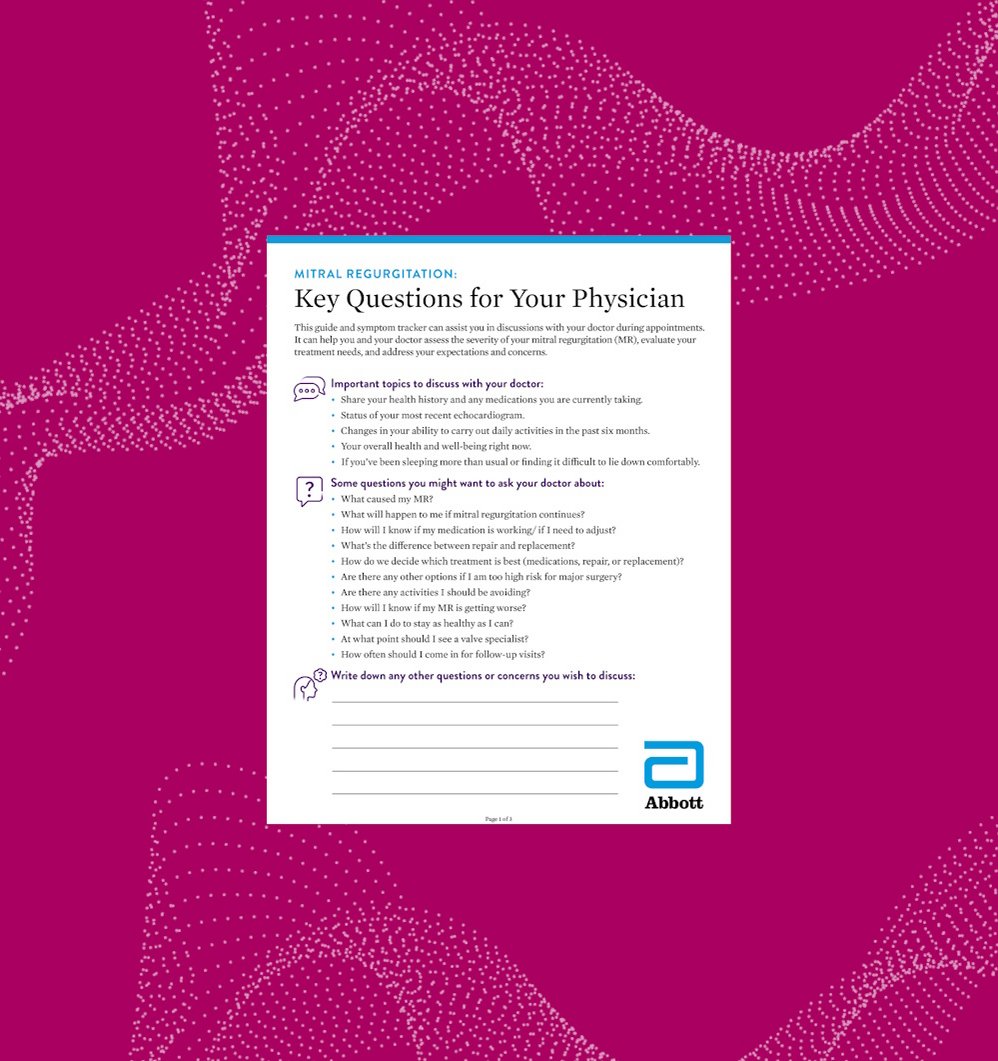

Download Discussion Guide

Find a MitraClip Therapy cardiologist near me

Find a cardiologist near me

Meet with a specialized care team experienced with the MitraClip Therapy procedure.
Important Safety Information

What is MitraClip™ Therapy approved for?

Available by prescription only.

MitraClip therapy is a minimally invasive procedure approved for treating patients with clinically significant mitral regurgitation due to either (a) a deteriorated mitral valve in patients who are deemed to be at prohibitive risk for surgery, or (b) mitral valve in patients who have heart failure and reduced pumping function who remain symptomatic despite maximally tolerated medications to treat their heart failure.

Patients should work with their doctor and a multidisciplinary heart team, which may include a heart surgeon and cardiologist with experience treating heart failure, to confirm their surgical risk and to ensure that they are on the optimal medications. The heart team will determine if transcatheter edge-to-edge valve repair is clinically appropriate, and if the patient meets the indications for the MitraClip procedure.

Who should not have the MitraClip Procedure?

Patients that have any of the following conditions may not be good candidates for the MitraClip Procedure: Patients with intolerance or allergy to procedural anticoagulation, untreatable hypersensitivity to implant components (nickel-titanium alloy, cobalt-chromium alloy), or active endocarditis or other active infection of the mitral valve.

What are the possible complications associated with the MitraClip Procedure?

As with any medical procedure, there is a possibility of complications. The most serious complications of the MitraClip procedure includes, but are not limited to: death, stroke (a condition in which decreased blood flow to the brain can result in brain damage and may cause severe disability), transient ischemic attack (stroke symptoms that last only a few minutes), major vascular complications (damage to a major blood vessel that may require emergency surgery or urgent cardiac surgery), life threatening bleeding event (a major bleeding event that requires a blood transfusion).  For additional potential risks and complications, please consult with your physician or heart team.

Talk to your doctor to learn more about the risks associated with MitraClip Therapy and ask for the detailed Important Safety Information if you'd like to review the full list of complications.

References:

  1. Stone GW et al. Five-year follow-up after transcatheter repair of secondary mitral regurgitation. N Engl J Med. 2023;388(22):2037-2048.

Data on file at Abbott.

MAT-2010280 v7.0 | Item approved for U.S. use only