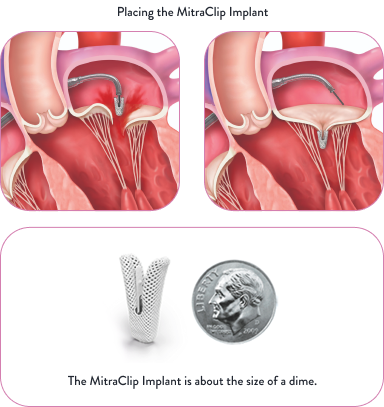
What is MitraClip™ Therapy approved for?
Available by prescription only.
MitraClip therapy is a minimally invasive procedure approved for treating patients with clinically significant mitral regurgitation due to either (a) a deteriorated mitral valve in patients who are deemed to be at prohibitive risk for surgery, or (b) mitral valve in patients who have heart failure and reduced pumping function who remain symptomatic despite maximally tolerated medications to treat their heart failure.
Patients should work with their doctor and a multidisciplinary heart team, which may include a heart surgeon and cardiologist with experience treating heart failure, to confirm their surgical risk and to ensure that they are on the optimal medications. The heart team will determine if transcatheter edge-to-edge valve repair is clinically appropriate, and if the patient meets the indications for the MitraClip procedure.
Who should not have the MitraClip Procedure?
Patients that have any of the following conditions should not have the MitraClip Procedure: inability to tolerate or are allergic or hypersensitive to anti-coagulants, anti-platelet therapies, nickel, titanium, cobalt, chromium, polyester, or contrast dye; have inflammation or rheumatic disease of the valve; have blood clots inside the heart or blood vessels (inferior vena cava, femoral vein), or active endocarditis or other active infection of the valve or have mitral or tricuspid valve anatomy which is deemed not suitable for repair with MitraClip.
What are the possible complications associated with the MitraClip Procedure?
As with any medical procedure, there is a possibility of complications. The most serious complications of the MitraClip procedure includes, but are not limited to: death, stroke (a condition in which decreased blood flow to the brain can result in brain damage and may cause severe disability), transient ischemic attack (stroke symptoms that last only a few minutes), major vascular complications (damage to a major blood vessel that may require emergency surgery or urgent cardiac surgery), life threatening bleeding event (a major bleeding event that requires a blood transfusion). For additional potential risks and complications, please consult with your physician or heart team.
Talk to your doctor to learn more about the risks associated with MitraClip Therapy and ask for the detailed Important Safety Information if you’d like to review the full list of complications.
CAUTION: Product(s) intended for use by or under the direction of a physician. Prior to use, reference the Instructions for Use inside the product carton (when available) or at www.eifu.abbott for more detailed information on Indications, Contraindications, Warnings, Precautions and Adverse Events.
Illustrations are artist’s representations only and should not be considered as engineering drawings or photographs. Photos on file at Abbott.
Unless otherwise specified, all product names appearing in this Internet site are trademarks owned by or licensed to Abbott, its subsidiaries or affiliates.
No use of any Abbott trademark, trade name, or trade dress in this site may be made without the prior written authorization of Abbott, except to identify the product or services of the company.
MAT-200XXXX vX.X | Item approved for U.S. use only
References: 1. Stone GW. et al. Five-Year Follow-up after Transcatheter Repair of Secondary Mitral Regurgitation. N Engl J Med. March 5, 2023. DOI: 10.1056/NEJMOA2300213 2. Arnold SV et al. Health status after transcatheter mitral valve repair in heart failure and secondary mitral regurgitation. JACC Mar 2019, 25951; DOI: 10.1016/j.jacc.2019.02.010 3. Mayo Clinic. Mitral valve regurgitation. Accessed June 16, 2025. www.mayoclinic.org/diseases-conditions/mitral-valve-regurgitation/symptoms-causes/syc-20350178 4. Cleveland Clinic. Can a Cough Be Related to Heart Issues? May 5, 2022. Accessed June 16, 2025. https://health.clevelandclinic.org/persistent-cough-it-may-be-a-sign-of-heart-failure 5. Phoenix Heart | Vein | Vascular. 6 Symptoms of Mitral Regurgitation. October 6, 2022. Accessed June 16, 2025. https://phoenixheart.com/6-symptoms-of-mitral-regurgitation/ 6. Cioffi G, Tarantini L, De Feo S, et al. Functional mitral regurgitation predicts 1-year mortality in elderly patients with systolic chronic heart failure. Eur J Heart Fail. 2005;7(7):1112-1117. 7. von Bardeleben, R. et. al. Real-World Outcomes of Fourth-Generation Mitral Transcatheter Repair 30-Day Results From EXPAND G4. JACC: Cardiovascular Interventions, 2023. Vol. 16. No. 12. doi.org/10.1016/j.jcin.2023.05.013